Introduce
Marine demand in Qatar is shifting from simply using boats to building and servicing them. Old Doha Port has been redeveloped into a marina and maritime events venue, and the third Qatar Boat Show, held there in November 2026, drew 546 brands and around 31,000 visitors, making it one of the fastest-growing boat shows in the Gulf. With a cruise terminal, waterfront residential districts and berths now in place, the leisure fleet and its maintenance demand have grown with them. The other half of the demand is working craft: fishing fleets, coastal transport, harbour patrol and offshore oil and gas support vessels operate year round in heat and salt spray, so hull repair and replacement are routine.
On the supply side the pattern is clear: a substantial share of complete boats is imported, while local firms concentrate on building, refitting and repair — small in scale but complete in craft, with hand lay-up still dominant.
Building a hull that is strong and delivered on time is not simply a matter of choosing the right resin. The reinforcement has to match the lay-up process, the location on the hull and the strength requirement. Too many plies, a poorly matched mat-to-roving weight ratio, weak interlayer stitching or joints that cannot be staggered will all affect lay-up efficiency and the quality of the finished hull.
What Qatari Boatyards Are Up Against
A hand-laid hull runs outward from the mould: gelcoat, surface mat, chopped strand mat, alternating mat and woven roving for several plies, local reinforcement, then structural bonding. The ply count follows hull type and strength requirement, and a dozen or more is normal. Several requirements have to be met at the same time:
01. Ply count and labour hours
Every extra ply costs time to cut, place and roll out. Qatari yards are generally small, order flow is uneven and labour turnover is high, so once hours slip, delivery dates slip with them.
02. Interlaminar density
The more interfaces between plies, the more opportunity for trapped air. Trapped air is where delamination and water ingress begin, and in high ambient temperatures the exotherm runs fast, making bubbles harder to release.
03. Joints and overlaps
Joints must be staggered ply by ply. Where they cannot be staggered they become a step in thickness, and air collects under that step during rolling. More plies means more complex staggering and greater dependence on operator experience.
04. Hull strength and surface quality
Bottom and topsides carry water pressure and wave impact, the deck carries people and equipment, and the outer surface has to be fair — no weave print-through and no excessive sanding before painting.
Our Solution: 600 g/m² Woven Roving + 450 g/m² Combo Mat
Rather than recommending a generic mat, we started from the customer’s actual process: hand lay-up of a glass fibre reinforced hull.
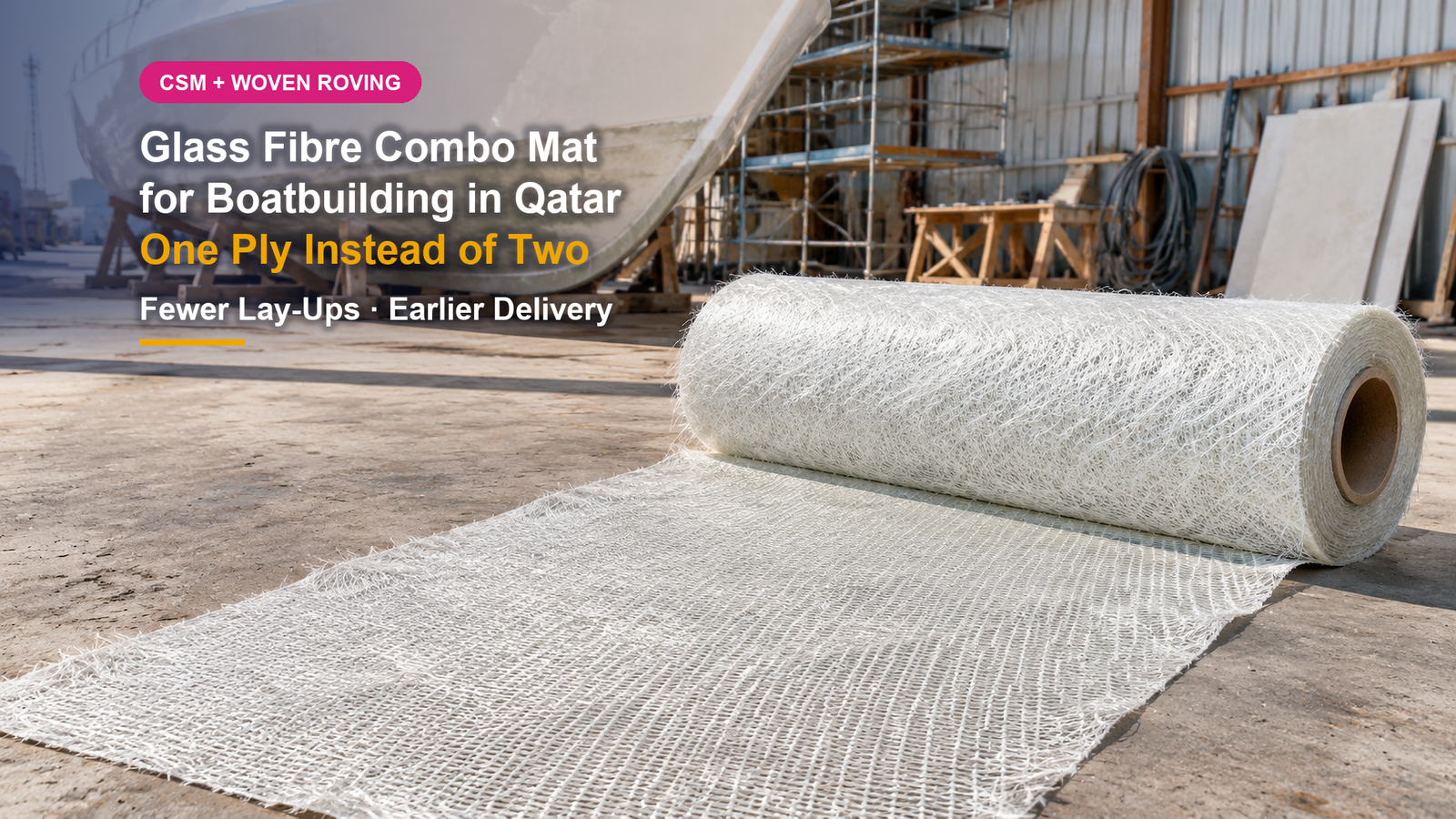
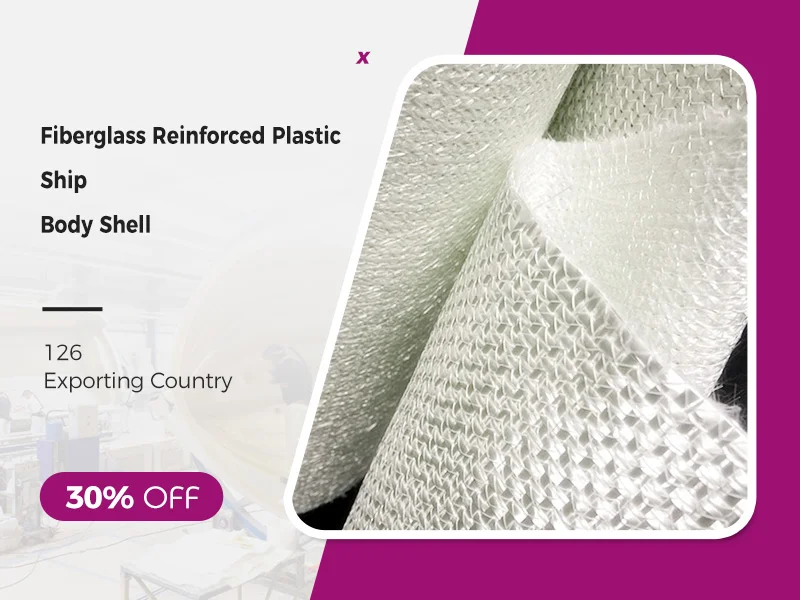
Combo mat is woven roving and chopped strand mat stitched together after forming, held by stitching rather than adhesive. This specification pairs 600 g/m² woven roving with 450 g/m² chopped strand mat — 1,050 g/m² in total — so one ply completes both the mat layer and the load-bearing layer.
one ply completes both the mat layer and the load-bearing layer. Why 600 with 450?
A defined weight combination. The 450 g/m² mat faces the mould, filling minor surface irregularity and separating the gelcoat from the structural plies; the 600 g/m² roving faces outward and provides strength in two directions. Together they come close to the thickness of two conventional plies while leaving one interface.
Stitched, not glued. The layers are held by stitching thread, so resin can flow between them through the stitch points instead of meeting an adhesive film that blocks it.
A controllable resin path. The mat side takes more resin, the roving side less, and rolling drives resin from the mat into the roving, wetting both out in one pass — provided enough resin is applied and the roller reaches the roving.
Process fit. Width, stitch spacing, roll length and the weight ratio between the two layers can all be set to the laminate schedule; on the same equipment, changing hull type means changing specification, not re-planning the process.
Starting from one defined specification means a Qatari yard no longer has to trial its way through how much mat, how much roving and whether to stack them itself. The material choice can be settled directly against the laminate schedule and the hull type.


How 600 + 450 Helps Solve the Production Problems
01. Faster lay-up
One ply replaces two, so a dozen lay-ups become seven or eight at the same wall thickness. Cutting, placing and rolling hours fall together, and the laminate schedule becomes easier to standardise: new operators come up to speed faster and quality no longer rests entirely on the most experienced hand.
02. A tighter laminate
Halving the number of interfaces halves the opportunity for trapped air. The stitched structure makes the two layers act as one load-bearing unit, and air leaves at the edges during rolling instead of being trapped inside.
03. Fewer joints
Fewer plies means fewer joints, simpler staggering and fewer thickness steps. At the sheer and bow knuckle, where curvature changes sharply, a few cuts along the corner take less time than forcing the material down and leave no void between mat and mould.
04. A more reliable hull
The woven roving carries load in two directions while the mat provides interlaminar bonding and a resin-rich transition. By adjusting lay-up sequence, resin content and ply count, a manufacturer can arrive at the reinforcement structure each hull design needs; laying the mat face to the mould and the roving outward also keeps the weave from printing through to the back of the gelcoat.


In Summary
Qatari yards work with small batches, many hull types and a mobile workforce. Under those conditions, cutting the number of lay-ups is more reliable than raising operator skill, and 600 g/m² woven roving with 450 g/m² mat does that work at the material end: one ply instead of two, half the interfaces, and less pressure from overlaps and staggering.
The customer does not have to choose on price alone or on a generic specification; the specification can be set against the lay-up process and the structural requirement of the finished hull. For us, every laminate schedule stands for a specific set of production conditions, and matching the material to those conditions is the real work of supply.
Looking for glass fibre combo mat for FRP hull production? Contact Hebei Yuniu Glass Fibre Manufacturing Co., Ltd. for datasheets and samples, or to discuss a custom weight combination against your hull type and laminate schedule.