Introduce
The continued growth of Peru’s agricultural exports is changing what field infrastructure has to deliver. Grapes, blueberries, and avocados are concentrated on the arid coastal strip, where planting and crop protection both depend on reliable water storage, fertigation, and spraying capacity. The FRP tanks that serve agricultural machinery — sprayer and fertilizer tanks, field water tanks, buffer tanks in fertigation and irrigation systems — have accordingly moved from one-off fabrication to routine batch production.
These tanks fail in only two ways, and either one is enough to lose a season’s programme: leaks, seeping out through the shell, a seam, or a flange and putting water and spray solution on the ground instead of in the tank; and cracking, starting at a flange, a nozzle, or the chassis mounting and widening over hundreds of kilometres of field track. Neither shows at despatch. Both show after the tank is full and has been in service. The question manufacturers there cannot avoid is how to stop those two outcomes inside the workshop.

Core Challenges for Agricultural Tank Manufacturers in Peru
Three long-standing problems, and all of them end in a leak or a crack.
Uneven wall thickness and trapped air: the first path to a leak. A hand-laid tank builds its wall ply by ply, and every extra ply brings another overlap, another chance for trapped air, dry patches, and thin spots. None of it shows at despatch; it seeps through the shell and the overlaps once the tank is filled and pressurised.
Vehicle vibration and field impact: cracking that starts where stress concentrates. A tank fixed to a trailer or sprayer absorbs road shock and liquid sloshing the whole way. Stress collects at openings, flanges, and the mounting, and if the reinforcement is unbalanced in warp and weft or the interlaminar bond is weak, a crack starts at exactly those points and grows with every trip.
Fertilizer and pesticide media combined with coastal UV: both faces accelerating the first two failures. The inside sits in long contact with urea, nitrate nitrogen, and spray solutions, and once its impermeability goes, seepage follows slowly. The outside chalks and exposes fibre under high irradiance, wall strength drops, and cracks initiate more easily. Neither side causes a failure alone, but together they bring the leak and the crack forward.
Our Targeted Solutions with Precision-Woven E-Glass Woven Roving
Three problems, but only two directions to solve them: make the wall itself tight and even, and keep the structure from splitting under load. Centred on our 800 g/m² E-glass woven roving in 1270 mm width, we work on all three fronts — wall build, seams, and interlaminar bond.
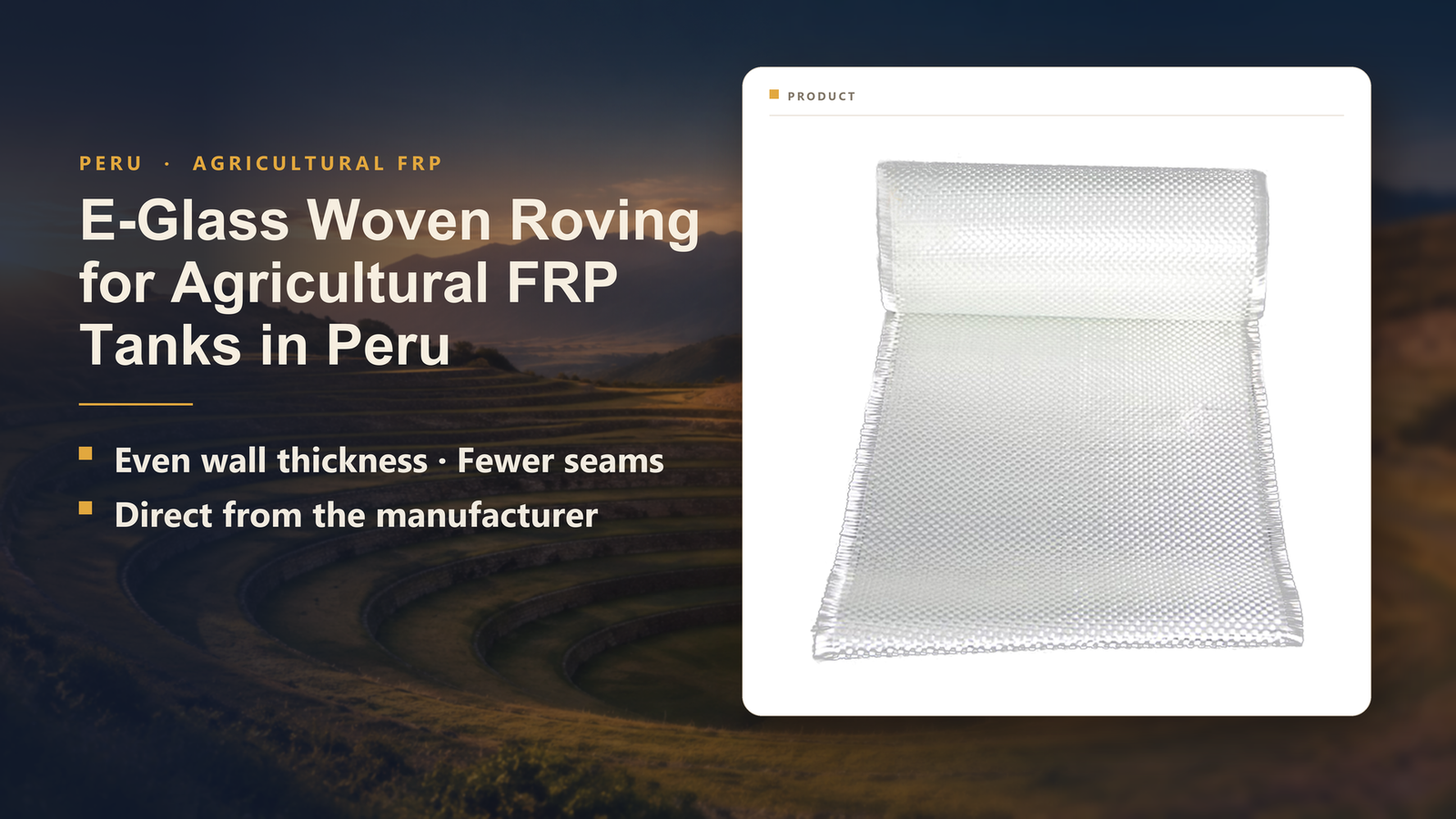
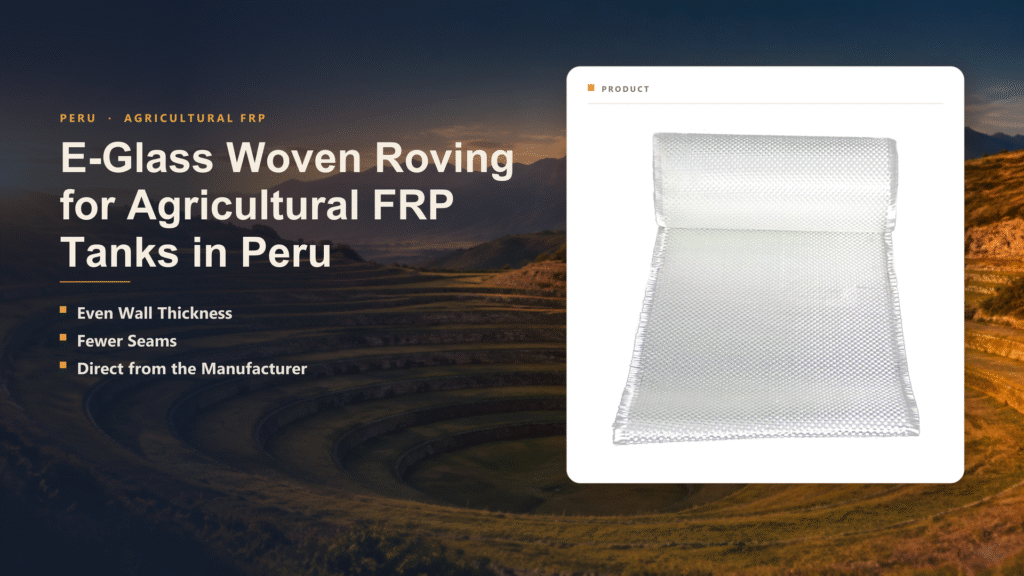
It is a standard reinforcement for hand lay-up and spray-up: a heavy single ply that reaches design thickness in fewer layers, an interlaced structure giving balanced strength in both load directions, and an E-glass composition that, with polyester or vinyl ester resin, suits tanks in long contact with water and fertilizer solutions. We are a fiberglass manufacturer with more than twenty years on the line, and our production experience sits precisely where weight, width, and weave have to match a customer’s process.
In a typical tank laminate it works alongside surface mat and chopped strand mat: the gelcoat and surface mat handle media resistance and impermeability on the inner face, the woven roving carries the structural load, and alternating the two is what delivers thickness and tightness together. That division of labour is how leak resistance and crack resistance are separated in the laminate design.


Fewer Plies for an Even Wall, Closing the Leak Path Through the Shell
To address leaks caused by uneven thickness, we treat weight as a process parameter first.
At 800 g/m², reaching a given wall thickness takes noticeably fewer plies. One ply less means one overlap less, one consolidation pass less, one interface less where air can sit — and for a shop producing several tanks a day, that directly cuts thin spots, dry patches, and resin-rich pockets. Thickness consistency then rests on process discipline rather than an experienced hand. In a tank that holds liquid, an even, tight wall is the first line against leakage.
Width Laid Out to the Circumference, Removing the Longitudinal Seam as a Leak Path
To address seam leakage, width is itself an engineering parameter.
At 1270 mm, wrapping a cylindrical shell takes fewer longitudinal overlaps, and the run into the base knuckle is easier to make as a single piece. Fewer seams means fewer potential leak paths, and cutting waste and stitching time fall with them. On larger diameters, matching width to circumference also changes throughput: the same hours lay up more tanks.
Weave and Wet-Out Control, Holding the Interlaminar Bond Against Cracking and Seepage
Cracking comes down to interlaminar bond and surface tightness, and both depend on weave and wet-out.
Plain weave gives balanced strength and dimensional stability in both directions, which suits a shell loaded in two axes. Where curvature changes sharply or impact resistance matters more, twill weave disperses and absorbs energy better and conforms to the shape. We supply either, matched to the customer’s lay-up practice.
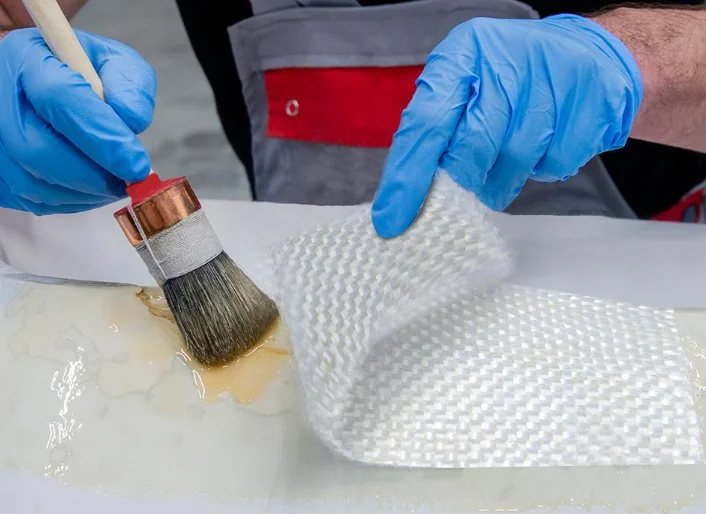
Wet-out is the most overlooked step with heavy woven roving. A 800 g/m² cloth is thick and its yarn bundles are large; incomplete wet-out leaves white fibre and dry patches, the interlaminar bond fails, and the defect shows first as seepage, then as delamination cracking under vibration. We control sizing type and content, strand dispersion, and moisture content so the cloth takes resin at a normal hand lay-up pace and releases air under the roller.
Surface evenness governs ageing on both faces as well: woven roving prints through easily, and only with a surface mat over it does the inner face come out tight and smooth, limiting penetration of the medium into the laminate. The outer gelcoat and surface layer then stay intact too, and resist early chalking under high UV.

Verified Production and Quality Results
A specification is worth only the tolerance it is held to. A leak and a crack correspond, in the workshop, to a set of parameters that are checked batch by batch:
- Basis weight and width verified per batch, so no roll runs light or narrow and throws out the lay-up calculation and wall thickness
- Warp and weft density and weave pattern checked against the loom setting, so the finished cloth matches the sample and strength does not fall away in one direction
- Sizing type and content controlled to formula, matched to the resin system in use, protecting wet-out and interlaminar bond
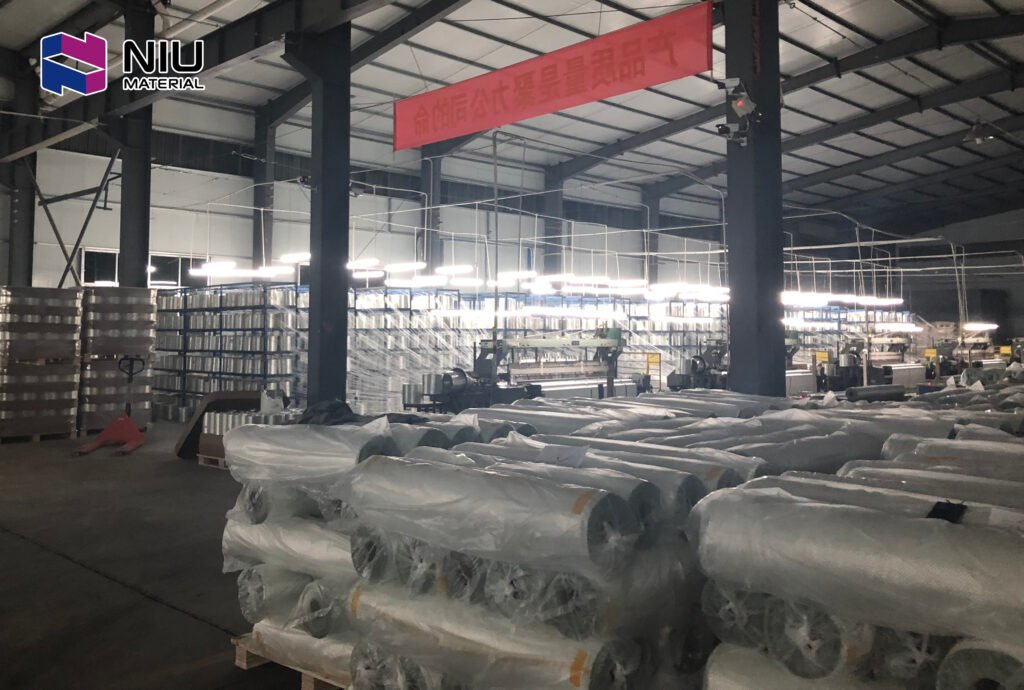
- Roll length, packing, and number of joints inspected roll by roll, so each roll runs continuous and lay-up needs no extra overlaps
- A test report with every batch, and basis weight, width, roll length, and batch number marked on the roll for traceability
- Technical datasheet and MSDS available for the 800 g/m² specification, so a customer’s process and compliance teams can check it before anything ships

Wider Applications Beyond Agricultural Tanks
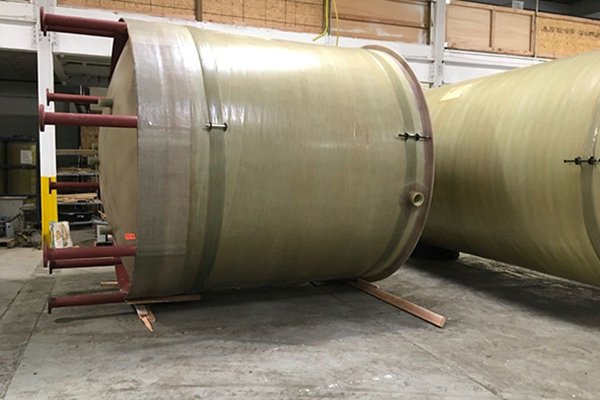
The same E-glass woven roving reaches well beyond tanks: FRP storage and transport vessels, chemical and anti-corrosion piping, hulls and decks, cooling towers, swimming pool shells, gratings and profiles, and general hand lay-up and spray-up work. The problems they face come from the same source as an agricultural tank’s — walls that must be even, seams that must be few, and layers that must hold together.
Selection logic holds across them: thin-walled or complex shapes take a lighter weight, thick-walled or load-bearing parts take a heavier one, and width should sit as close as possible to the developed size of the part to limit stitching. As a manufacturer, we can also customise weight, width, weave, roll length, packing, and surface treatment to different processes and performance requirements.

Why Choose Us as Your Fiberglass Woven Roving Manufacturer
As a fiberglass manufacturer serving South American, Middle Eastern, and European markets, we bring three core strengths:
Strict and consistent quality control: control points from incoming strand through to the finished roll keep basis weight, width, and weave to the agreed standard on every roll, with a test report for every batch — consistent input is what makes a stable leak rate and a predictable cracking risk possible.
Custom development capability: our process team works backwards from your resin system, lay-up practice, and tank dimensions to set weight, width, plain or twill weave, sizing type, roll length, and packing.
Export delivery support: shipping plans laid out in weeks, documents issued consistently from the same entity, and long-term email follow-up, so lead times and paperwork do not drift during the quiet stretches of a buying cycle.
Summary
Our 800 g/m² E-glass woven roving in 1270 mm width is a proven high-performance reinforcement for FRP tanks used in agricultural machinery. A heavy single ply means fewer layers and a more even wall, 1270 mm width means fewer longitudinal seams in the shell, and consistent weave and thorough wet-out mean the interlaminar bond holds — so the two routes a tank fails by, leakage and cracking, are closed off at the manufacturing stage instead of being discovered in the field.
If you are an FRP tank manufacturer, agricultural equipment builder, or fiberglass products trader in Peru or across South America looking for a reliable manufacturer, contact us for samples of the 800 g/m² specification, technical datasheets, and batch test reports, or to discuss width and roll length against your tank dimensions.