
Introduce
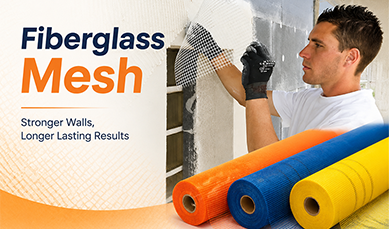
Fiberglass mesh is one of NIU® MATERIAL‘s core products. It is mainly used for wall reinforcement and render strengthening, interior insulation protection, waterproofing and backing, and cement board or plasterboard applications. Standard specifications are 145 and 160 g/m² (4×4, 4×5 and 5×5 mm openings) and 60 and 80 g/m² (2×2 and 3×3 mm openings); colour, width, roll length, packaging and printed branding can be customized for your market.
15% Is Not Skimping — It Keeps Mortar Flowing Through: Why UK Wall Reinforcement Wants This 160 g/m², 4×5 mm
The two most common failures in wall render are hollowing and cracking. Hollowing happens when the render never truly keys to the substrate; cracking happens when the reinforcing layer breaks first, or never receives enough mortar. UK wall reinforcement rests on three fixed conditions: substrates are mostly block or old brick, render layers are thick with strongly alkaline mortar, and application is largely by hand. The 160 g/m², 4×5 mm, 15% coating specification was drawn up against those two failures.
- 160 g/m² — so the mesh itself does not break first. Too light and tensile strength falls short, so the mesh snaps when the render cracks; too heavy and it turns stiff, springing back at corners, window reveals and internal angles where workers cannot press it down — and wherever it will not lie flat becomes hollowing later. 160 g is the balance between holding the load and lying flat.
- 4×5 mm openings — so the render actually keys to the substrate. Hollowing comes from poor keying. Too small and mortar or putty cannot pass, leaving the mesh floating inside the render; too large and there are too few keying points. 4×5 mm lets mortar flow through and form a continuous mechanical key on the reverse side, pinning the whole render layer to the substrate.
- 15% coating — so the openings stay open and the anchor holds. This is the most misunderstood item. Below 15% the yarns loosen and strength suffers; above 15% coating builds up and blocks the openings, so mortar cannot pass and the mesh turns from a reinforcing layer into a separating layer — stiffer in hand, yet far more prone to hollowing and cracking. 15% is the proven balance between strength and open mesh.
- Alkali-resistant coating — so the reinforcement does not fade with time. Cement-based mortar is alkaline, and ordinary glass fiber is attacked over years. The coating formulation decides how much reinforcement the mesh retains once buried in render — cracking is often not about being too weak at the start, but too weak several years later.
- Width and roll length — so site work introduces no avoidable misses. Widths of 1.1 m and 1.2 m suit single-worker application and lapping, while 1 m suits narrow walls and patch repairs; a 50 m roll balances roll weight against how often workers must change rolls, cutting carrying and downtime on scaffolding. Apply it smoothly, and lapping and missed spots become far less likely.
The answer forms one chain: if mortar passes through the openings and keys to the substrate, the render will not hollow; if the mesh is strong enough and is not eaten away by alkali, the render will not crack. That is exactly what this 160 g/m², 4×5 mm, 15% coating specification does for UK walls — and why we recommend it for that market.


15% or 20%? Two Batches of Samples — How the Specification Was Settled
When choosing mesh, clients most often stall on the same question: how much coating should the mesh have? Instinct says “more coating, stronger mesh,” but in engineering the answer is usually the opposite. The four steps below are how we explain and verify this; if you are weighing coating content, sample validation or packaging differentiation, they should speak to your questions.
Let testing break the “more coating is better” instinct
The misconception is common: treating coating content as the only measure of strength and asking for 20% outright.
The right response is not argument but evidence. We send a free 20-meter sample at 20% coating content so the client can test it, tear it and compare for herself, and we lay out the process physics honestly: above 15%, coating builds up and blocks the openings, mortar cannot pass, and the mesh turns from a reinforcing layer into a separating layer — more prone to hollowing and cracking on site, exactly the failure no builder tolerates.
With both samples in hand, the conclusion becomes self-evident: more coating does not mean better performance. Before discussing coating content, first ask whether mortar can pass through.
When a sample is called “weaker,” send the whole range and let it speak
Comparing a sample against the incumbent supplier’s product is a buyer’s instinct; once it is judged “weaker,” the order can go elsewhere.
Arguing “ours is actually not weak” is the least useful response. We let the samples speak: we send a set of samples at different coating contents in one go for testing under a single standard — strength, hand feel, opening clarity, flex and recovery — and then put the physical samples on the table in person, so the difference in opening clarity at different coating contents is visible at a glance.
After a few rounds, the judgment corrects itself: strength is never a single indicator — open mesh and workability are just as vital.
Write the parameters down, or the specification will not hold
“Roughly the same weight,” “about this mesh size” — leave that kind of vague wording outside the paperwork and it turns into disputes and rework later.
Our approach is plain: match the application, local market habits and product parameters one by one, and put the details most easily taken for granted on paper for confirmation — weight, openings, width, roll length, printing and guide lines, one item at a time. Only after confirmation does the specification really land: 160 g/m², 4×5 mm openings, 1.1 m or 1 m width, 50 m per roll, white, printed as required with the red company logo and red guide lines, or with three black guide lines, at 15% coating content.
Getting the specification right is the precondition for everything that follows — and the step we are least willing to skip on any project.
Beyond the Product — Three Things Clients Get Stuck On: Packing and Acceptance, a Stock-Out Window, Container Space
Many of the hardest parts of a cooperation sit outside the product — clients know them better than we do, and can do less about them. These three come up most often, and they are exactly what we can take off your hands.
One: how rolls should be packed and quality accepted cannot be settled over a screen. Long-distance email exchanges never quite close these two questions, and a client cannot simply impose an answer. What we can do is move them to a room: meeting at an exhibition booth, or visiting the client’s market, settles packing and acceptance on the table — where it happens fastest.
Two: when the market runs short, what clients fear most is supply they cannot get. Sites are waiting and channels are pressing, and demand turns urgent overnight — and all the client can do is wait. What we can do is catch that urgent order: specification, packaging and lead time confirmed immediately, production scheduling locked in at the same time. Keeping supply unbroken while others run dry is worth more than any promise.
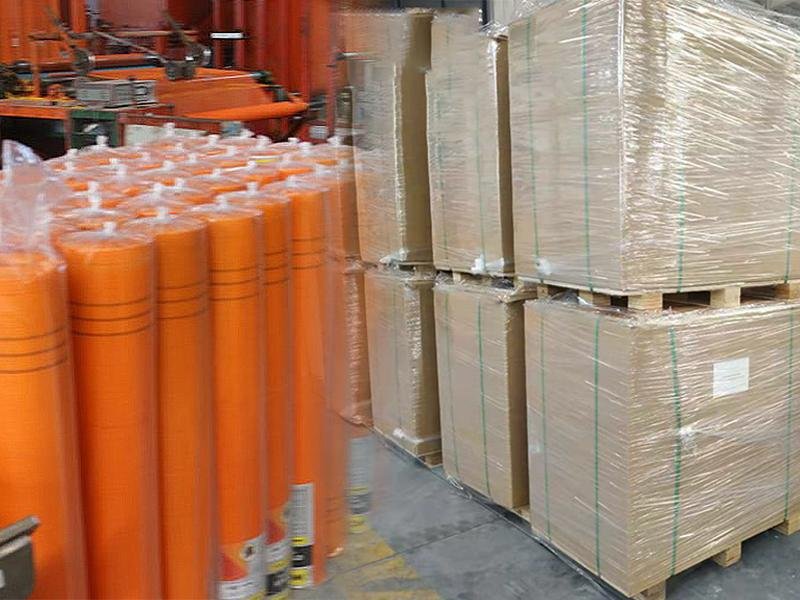
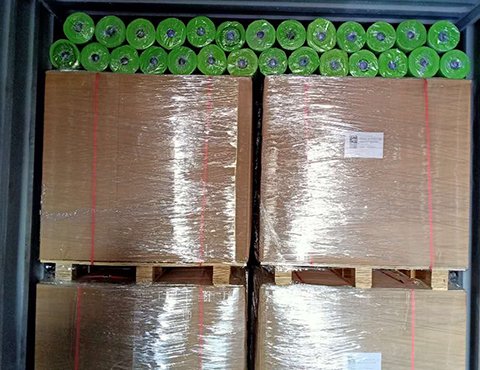
Three: mixed roll widths in one shipment waste container space. 1.1 m and 1 m rolls rarely fill a container under standard loading, and the client has no easy way to re-plan on loading day. What we can do is rework the plan for you: re-arranging and stacking the two widths so every cubic inch earns its keep — shipment volume rises beyond the planned figure, and each container carries more with no cubic space wasted.
The "Dry Patch" Pipe and Tank Makers Fear Most — How to Choose Your Mat
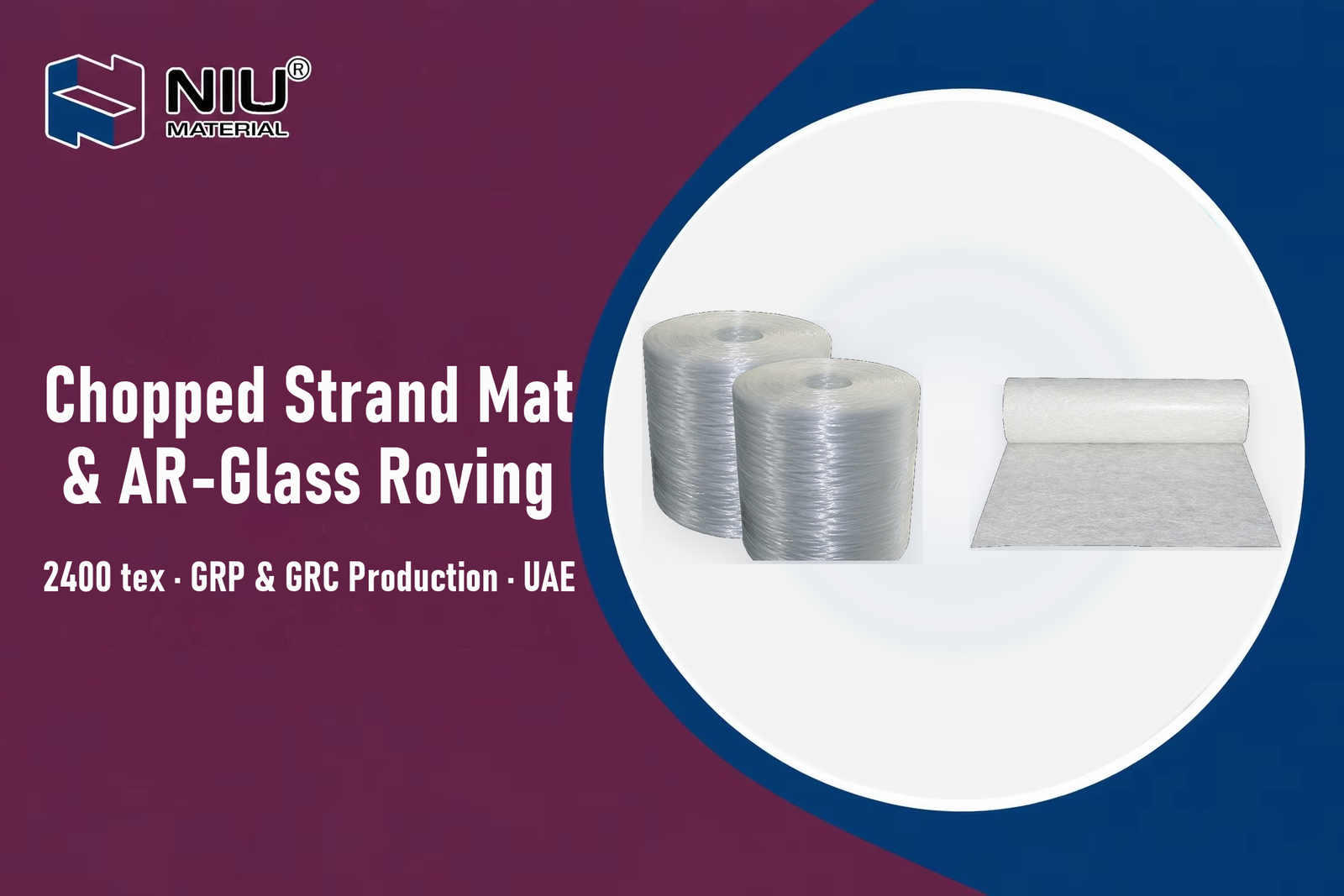
If you produce GRP pipes and tanks, only four product indicators really matter — they decide whether the finished part shows white spots, delamination and pinholes, and whether wall thickness and strength stay consistent.
Wet-out and air release. Curved surfaces are laid up by hand or wound by machine, so resin must penetrate quickly and trapped air must escape. Poor wet-out leaves dry patches on curved surfaces — the first thing hydrostatic testing exposes.
Weight uniformity. A stable mat weight gives stable resin uptake, so wall thickness and strength do not drift along a pipe run or across a tank body; weight variation needs to sit within a reasonable band, and roll weights must be standard.
Interlaminar bonding. When alternated with woven roving and roving, chopped strand mat bridges and ties the reinforcement layers together against soil loads on buried pipe and thermal movement.
Corrosion resistance. These pipes carry water, sewage or chemical media; the resin-rich inner liner is the first line of defence, and it is formed on a chopped strand mat backbone.
A GRP pipe and tank producer in Oman uses exactly this specification — 300/450 g at 1250 mm width, emulsion-bonded. Next time, we go deeper into how to choose and how to use it.


About Us
NIU MATERIAL, based in Hebei, China, was founded in 2012 and has over two decades of experience in fiberglass products. Our Hebei base operates one of North China’s leading fiberglass mesh production lines, and our products are certified to SGS, CE and ISO9001, exported to Europe, the Middle East, Southeast Asia, Africa and Latin America, serving manufacturers and distributors in building reinforcement, insulation protection and composites molding.
Whether you need volume supply of standard specifications or customized development for a specific market, we support the entire journey — product selection and sampling, technical parameter discussion, packaging design, container loading optimization and on-time delivery. We explain specifications thoroughly and get the details right, so we can be the material partner you rely on for the long term.
Clients worldwide are welcome to inquire about fiberglass mesh and other glass fiber products — we would be glad to solve your real problems with the right specification. ers and distributors in building reinforcement, insulation protection and composites molding.
Whether you need volume supply of standard specifications or customized development for a specific market, we support the entire journey — product selection and sampling, technical parameter discussion, packaging design, container loading optimization and on-time delivery. We explain specifications thoroughly and get the details right, so we can be the material partner you rely on for the long term.
Clients worldwide are welcome to inquire about fiberglass mesh and other glass fiber products — we would be glad to solve your real problems with the right specification.