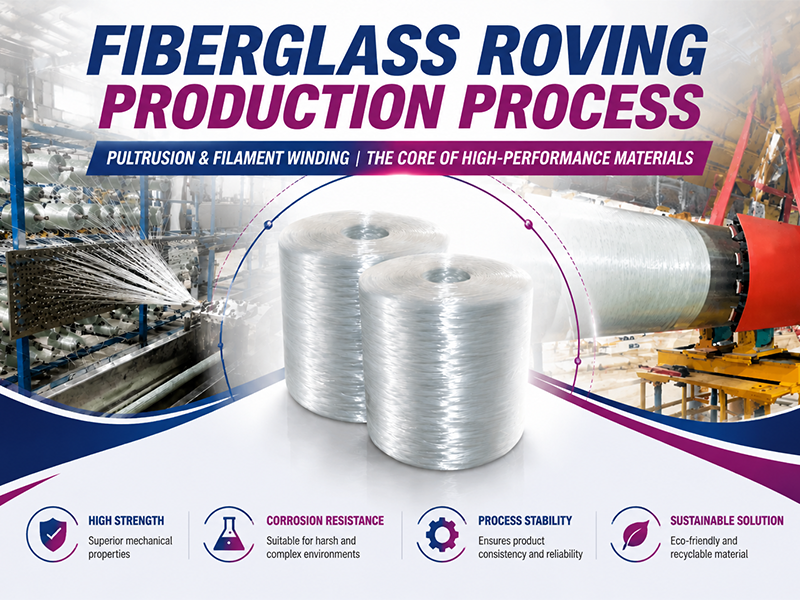
The Ultimate Guide To Purchasing Textile Reinforcement Glass Fiber Roving
Table of Contents
Add a header to begin generating the table of contents
Introduce
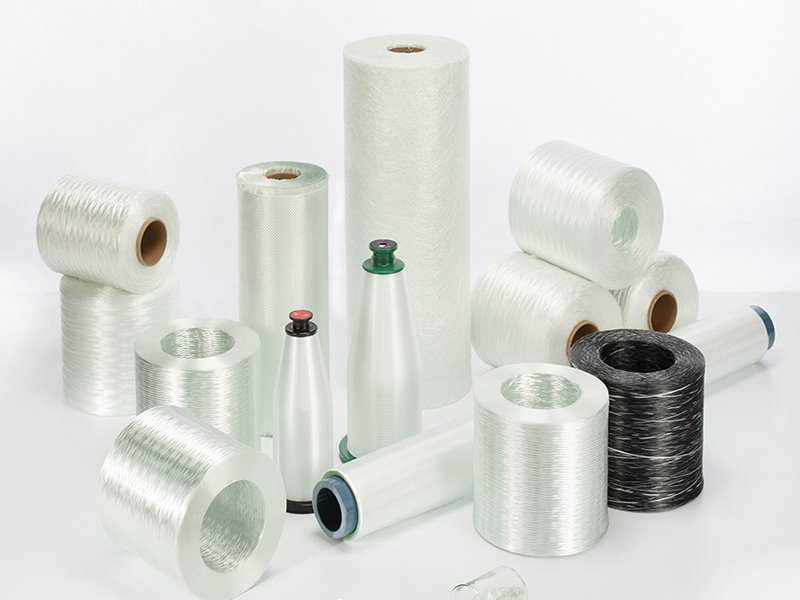
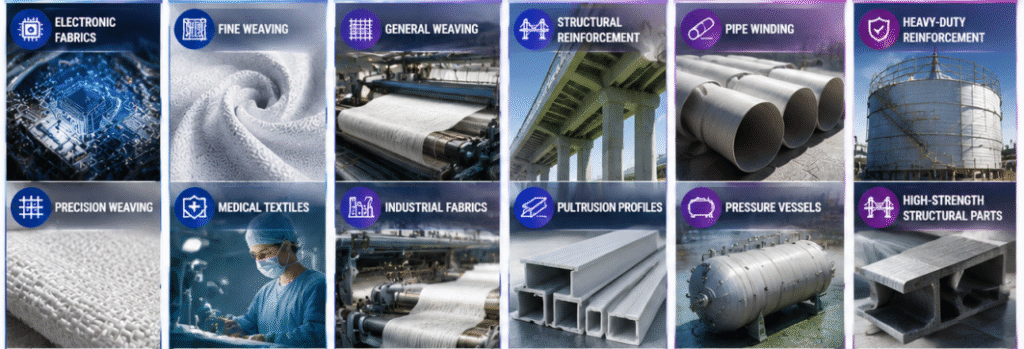
In the composite material and textile reinforcement industry, glass fiber roving is an indispensable core reinforcing base material, widely used in construction reinforcement, wind power new energy, automotive lightweighting, electronic insulation, gypsum products, and many other fields. Many procurement and production managers often encounter these challenges: huge price gaps for the same type of roving, inconsistent batch stability, frequent roving breakage and fuzzing during weaving, unqualified finished product strength, delamination and aging in later stages. Choosing the wrong model directly leads to product rework and soaring costs.
As a professional source manufacturer with 24 years of deep cultivation in the glass fiber field, YUNIU serves more than 3,000 end customers in 128 countries around the world. We fully understand the common pain points in purchasing—focusing on price over compatibility, lack of parameter knowledge, and difficulty in distinguishing quality. Today, we have compiled this exclusive ultimate purchasing guide from the full dimensions of actual procurement, production, and finished product application.
Define the Application First: Focus on End-Use Needs, Avoid Blind Selection
The first step in purchasing textile reinforcement glass fiber roving is not to look at price or parameters, but to clarify your application scenario and production process, which is the foundation of choosing the right product. Different usage environments and production processes have vastly different performance requirements for roving; blind procurement will only result in insufficient compatibility or wasted performance.
For conventional indoor textiles, general composite reinforcement, gypsum products, and civil anti-corrosion applications, mainstream alkali-free glass fiber roving fully meets demand with excellent insulation, stability, and cost-effectiveness. For outdoor open-air, chemical corrosion, high-temperature and high-humidity working conditions, priority should be given to corrosion-resistant and high-temperature-resistant special modified glass fiber roving. For precision scenarios such as electronic insulation and precision weaving, high-precision roving with fine diameter, low tension, and no fuzz is required; for wind power, large structural parts, pultrusion and winding processes, high-strength and high-modulus coarse roving is needed to ensure structural strength of finished products.
YUNIU has a full-scenario glass fiber roving system, covering alkali-free, alkali-resistant, high-temperature resistant, electronic-grade, wind power-grade and other full-series models. We provide one-to-one accurate selection based on your scenario + process + resin system, rejecting blind selection and performance waste. We support OEM/ODM customization to quickly match different processes such as weaving, pultrusion, winding, and chopping, ensuring smoother operation and more stable finished products.
Understand Core Parameters: Avoid Industry Misunderstandings of Incomprehension and Wrong Selection
Most customers are easily discouraged by complex professional parameters when purchasing. In fact, you only need to master a few core indicators to accurately identify roving quality and avoid inferior products.
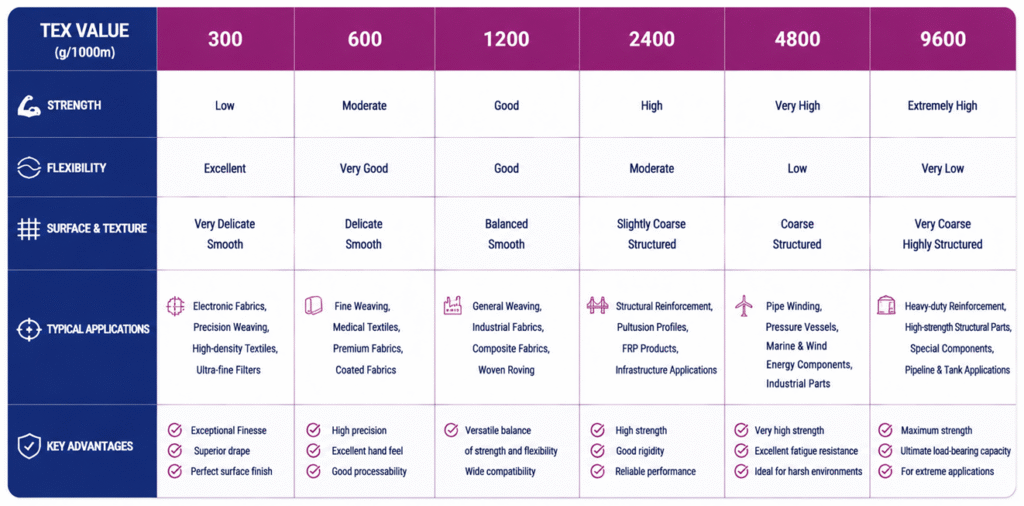
First is the Tex value (linear density), a key standard for measuring roving thickness. The higher the value, the thicker and stronger the roving; the lower the value, the finer and more flexible the roving. Low-Tex fine roving is suitable for precision weaving, electronic cloth, and high-density textile products, featuring delicate texture and flat forming. High-Tex coarse roving is ideal for structural reinforcement, pultrusion profiles, pipe winding, and other scenarios requiring extremely high strength.
Second is fiber diameter: fine fibers offer better flexibility and stronger resin interface bonding, resulting in higher flatness of finished products; coarse fibers have outstanding tensile strength and stronger deformation resistance, suitable for heavy-duty industrial products. In addition, moisture content and sizing type are easily overlooked key details—excessively high moisture content causes foaming, debonding, and poor adhesion in finished products, while high-quality roving has stable and controllable moisture content. Compatible sizing ensures perfect compatibility between roving and resin, greatly improving the overall strength and durability of composite materials. YUNIU can customize suitable sizing formulas according to your resin system and production process to meet various production needs.
All YUNIU products strictly control moisture content (below 0.15%) and sizing. Each roving’s Tex value, diameter, and strength are accurately managed in accordance with international standards such as ISO9001, CE, and SGS, with transparent and traceable data. We can customize sizing formulas based on your resin system to maximize roving-resin compatibility, significantly improving finished product strength, weather resistance, and qualification rate, ensuring quality from the parameter source.
On-Site Quality Identification: Quick Inspection Skills for Everyone
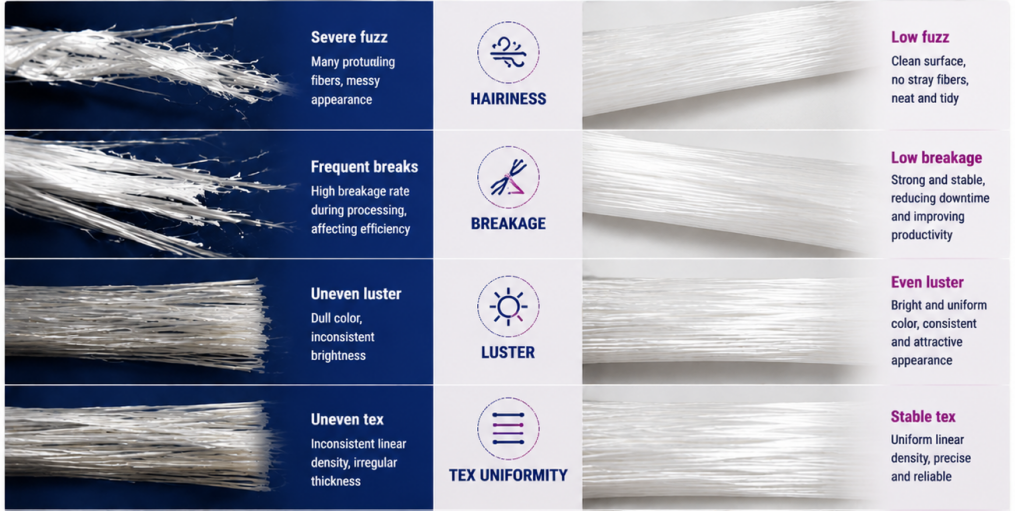
Many customers only discover roving fuzzing, frequent breakage, and large batch color differences after procurement, seriously affecting production efficiency. In fact, you can quickly identify quality advantages and disadvantages with simple steps upon receipt. High-quality textile reinforcement glass fiber roving has uniform appearance, transparent pearl white color, smooth surface, no obvious fuzz, agglomeration, breakage, oil stains, or impurities. It has uniform tensile toughness, not easy to brittle break or loose, with stable tension, and rarely fuzzes or breaks during weaving.
YUNIU insists on 100% virgin glass fiber raw materials, rejecting recycled materials. Our roving features pure color, no fuzz, few breakages, sufficient toughness, and smooth weaving. We provide free samples for your pre-test and inspection before ordering with confidence.
Choose a Reliable Supplier: Stable Supply Is the Core of Long-Term Production
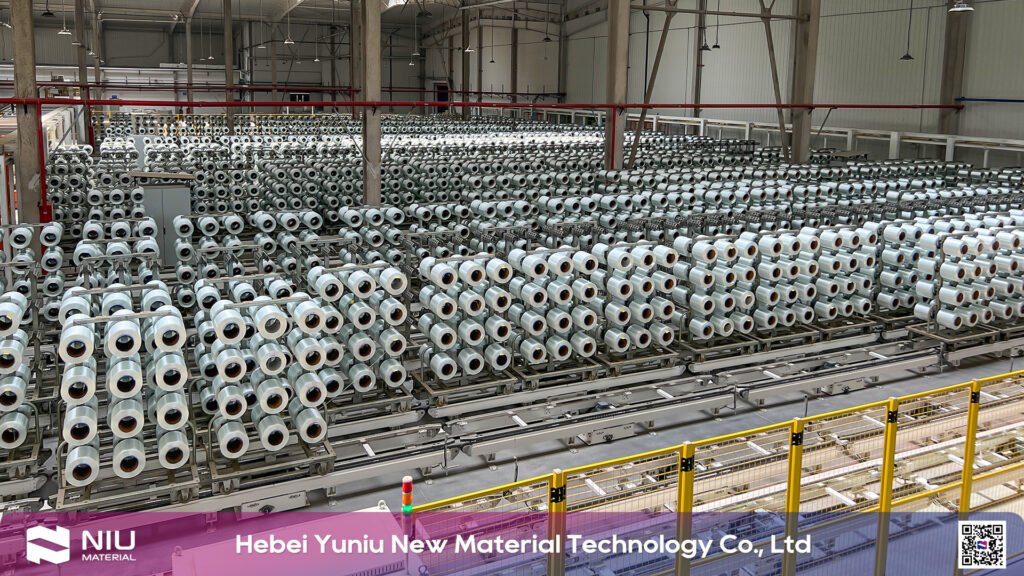
For large-scale enterprise production, roving quality stability, on-time delivery, and customization capability are more important than a one-time low price. When selecting suppliers, focus on factory production strength, quality control system, customization capability, and service experience. YUNIU has focused on the R&D and production of textile reinforcement glass fiber roving for many years, with automated production lines and full-process standardized quality control. Every procedure from raw material screening, spinning, twisting, surface treatment to finished product inspection is strictly controlled to ensure stable performance and accurate parameters of each batch.
For customers’ differentiated needs, we support personalized services such as specification customization, process adaptation, and sizing fine-tuning, suitable for full-scenario applications of textiles, reinforcement, and composite materials. We also provide precise technical docking to help you match the optimal product model, solve various problems in production and finished product adaptation, helping customers reduce costs, improve efficiency, and enhance product competitiveness.
Summary
The core of purchasing textile reinforcement glass fiber roving is not to choose the most expensive, but the most suitable. First clarify the application scenario and production process, then understand core parameters, master inspection skills, avoid procurement pitfalls, and finally select a reliable source supplier—you can easily achieve accurate purchasing. In the future, YUNIU will continue to deepen its cultivation in the glass fiber reinforcement material field, relying on 24 years of manufacturing experience, stable quality, cost-effective products, and professional technical services to escort the production and development of customers worldwide.
Please leave a message regarding the fiberglass and other composite materials you’re interested in or looking for.
We will send you a definitive quote (including product price and shipping costs) within 12 hours.
Product Inquiry/Quote
You can leave a message about the fiberglass materials you are interested in/looking for.
We will send you a clear quotation (including product price + shipping cost) within 12 hours.
Are you considering fiberglass for your application?
You can leave your needs and contact information~and We can provide you with usage suggestions + product suitability analysis + free sample delivery!
Leave us your interest and contact information, and we’ll send you detailed information for your reference!
Do you want to know the technical parameters and TDS of products?
You can leave the specifications and contact information you need~ Our technicians will immediately organize the exclusive information for you and send it to your email!
Interested in this specification?
You can leave your contact information here, and we will send you detailed specifications and application cases to make your purchase clearer~
How can we help you?
You can leave a message about the fiberglass materials you are interested in/looking for.
We will send you a clear quotation (including product price + shipping cost) within 12 hours.