
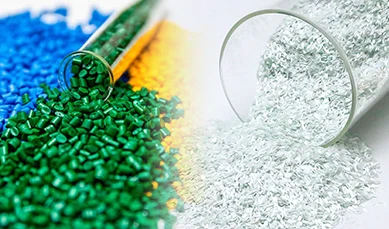

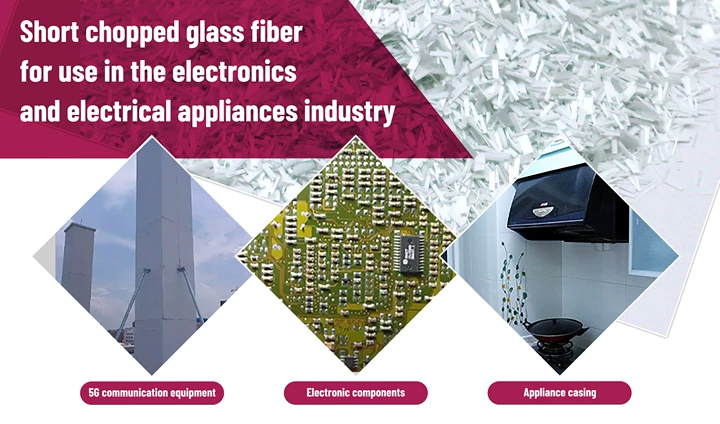
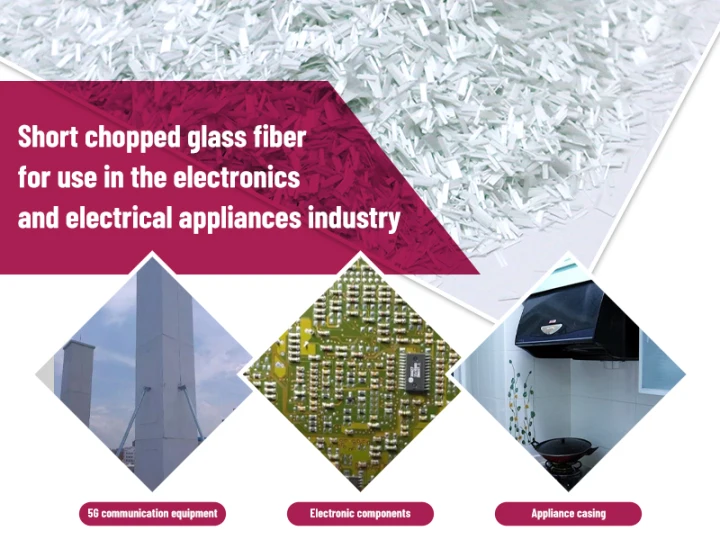
In the electronics and electrical industry, product lightweighting, high strength, insulation, dimensional stability, and temperature resistance are core factors determining market competitiveness. From home appliance housings and automotive electronic components to industrial electrical insulation parts and 5G communication equipment, glass fiber chopped strands play an irreplaceable role. By compounding with various resin matrices, they significantly enhance the material’s mechanical properties, heat resistance, and dimensional stability, while retaining excellent electrical insulation. This makes them a key material for achieving “high performance, lightweight, and long service life” in electronic and electrical products.
However, during actual procurement and application, many customers face similar dilemmas: Which type of chopped strand is suitable for different resin systems? Which length specification balances molding process requirements and product performance? Why can’t PA and PP chopped strands be used interchangeably? What special requirements do BMC/DMC processes have for chopped strands?
As a professional supplier deeply rooted in the glass fiber industry for many years, we receive numerous inquiries from customers in the electronics and electrical field regarding material selection. This guide is written entirely from the customer’s perspective. It breaks down the core specifications, selection logic, resin compatibility, process requirements, and pitfalls to avoid for glass fiber chopped strands used in the electronics and electrical sector. Our goal is to help you establish a scientific selection strategy, ensuring every investment translates into your product’s core competitiveness.
Unlike in the construction sector, the core of selecting chopped strands for electronics and electrical applications is “resin compatibility” + “process compatibility” . All specification parameters revolve around these two cores. As evident from product information, the selection logic for electronics-grade chopped strands is based on three core dimensions:
In the electronics and electrical field, the core function of chopped strands is to combine with resin to form reinforced composites. Therefore, the resin type is an absolute prerequisite for selection. Mainstream compatible resins in the industry include:
VE (Vinyl Ester Resin): Combines the corrosion resistance of epoxy resin with the processability of unsaturated polyester, offering excellent temperature resistance. Commonly used in high-end electrical insulation parts and anti-corrosion electronic components.
EP (Epoxy Resin): Exhibits excellent electrical insulation, adhesion, and mechanical properties. It is the core resin for electronic packaging, insulating structural parts, and PCB substrates.
PA (Polyamide/Nylon): Offers good toughness, impact resistance, and wear resistance. Commonly used in home appliance structural parts, automotive electronics, and connectors.
PP (Polypropylene): Features low cost, good chemical resistance, and excellent electrical insulation. It is the mainstream resin for home appliance housings and general electronic components.
PET/PBT (Polyesters): Provides good dimensional stability and fast molding. Commonly used in connectors, switches, and other electronic components.
Different resins have vastly different molecular structures, polarities, and processing temperatures. Consequently, the surface treatment and type of chopped strand required are completely different and absolutely cannot be mixed.
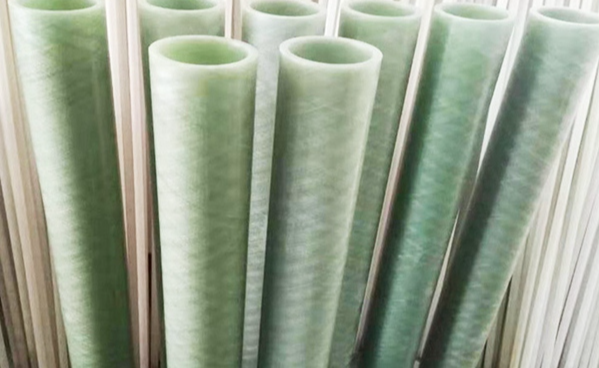
This is the most common pitfall for customers: PA chopped strands and PP chopped strands cannot be used interchangeably. While PA chopped strands can be used in PP resin, PP chopped strands must NEVER be used in PA resin. This is determined by the characteristics of the two resins and the surface treatment process of the chopped strands.
PA-specific Chopped Strands: Designed for the polarity and processing temperatures exceeding 250°C of PA resin, using a special silane coupling agent surface treatment. They offer strong interfacial bonding and high-temperature resistance. Suitable for engineering plastics like PA, PET, PBT, and also compatible with PP resin. They are a high-quality, versatile choice for engineering plastic reinforcement.
PP-specific Chopped Strands: Designed for the non-polarity and processing temperatures around 200°C of PP resin, using a surface treatment specifically adapted for PP. They are only suitable for non-polar general-purpose plastics like PP and PE. Their high-temperature resistance and interfacial bonding strength are completely inadequate for PA resin. Forced use will lead to interfacial debonding and product failure.
This is our red-line principle for all customers: When procuring PP chopped strands, their use must be strictly limited to PP resin. If your products involve both PA and PP resins, directly choose PA-specific chopped strands for multi-material use and to avoid selection errors.
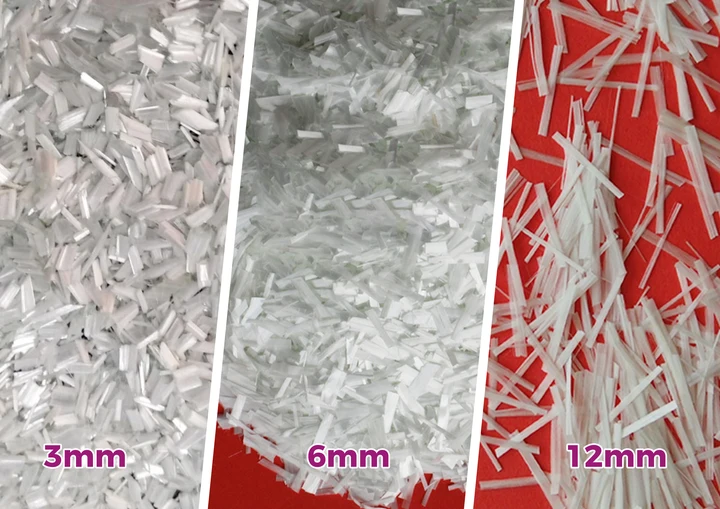
Standard lengths for chopped strands in the electronics and electrical field are 3mm, 6mm, and 12mm. These lengths are a golden range validated by countless industry processes, perfectly compatible with mainstream molding processes like BMC/DMC.
Longer length = Better reinforcement: Longer fibers form a more effective network structure, significantly enhancing the composite’s strength, impact resistance, and dimensional stability. Suitable for structural parts with high mechanical requirements.
Shorter length = Better process flow: Shorter fibers flow better during injection and compression molding, easily filling complex cavities. Suitable for thin-walled, precision, and complex electronic/electrical components.
Core Selection Principle:
3mm: Ultimate flowability. Suitable for thin-walled, precision, complex electronic components (e.g., connectors, switches), prioritizing molding accuracy.
6mm: The balanced “golden” specification. Combines reinforcement and flowability. Suitable for the vast majority of electronic and electrical products; the most common general-purpose length.
12mm: High reinforcement specification. Suitable for structural parts with high mechanical demands (e.g., industrial electrical insulators, load-bearing automotive electronic parts), maximizing product strength.
A core application process in the electronics and electrical field is BMC (Bulk Molding Compound) / DMC (Dough Molding Compound) . These processes have specific requirements for chopped strands: BMC-specific chopped strands undergo specialized surface treatment and chopping processes. They offer excellent resin impregnation, dispersibility, and flowability, allowing uniform dispersion in the bulk molding compound and avoiding fiber agglomeration. They are perfectly compatible with BMC/DMC compression molding processes. Ordinary chopped strands cannot be substituted, as this would lead to defects like pinholes, uneven strength, and surface imperfections, significantly increasing the reject rate.
The core of selection is not “choosing the most expensive,” but “choosing the most suitable.” Based on our experience with different customer product types, processes, and pain points, we have summarized a complete selection strategy:
Customer Profile: Automobile manufacturers, automotive brands. Products: Brake pads, engine covers, water tanks. Core needs: Cost control, strength improvement.
Recommended Solution:
Resin System: PP/ABS/General Engineering Plastics
Chopped Strand Type: BMC chopped strands
Length Specification: 6mm (golden balance, good reinforcement and injection flowability).
Process Compatibility: General-purpose, suitable for injection molding and BMC/DMC molding.
Pitfall Warnings: Using only PP resin? You can choose PP-specific strands for further cost reduction, but strictly prohibit their use in PA or other engineering plastics. For ultra-thin-walled parts, choose 3mm length for better flowability.
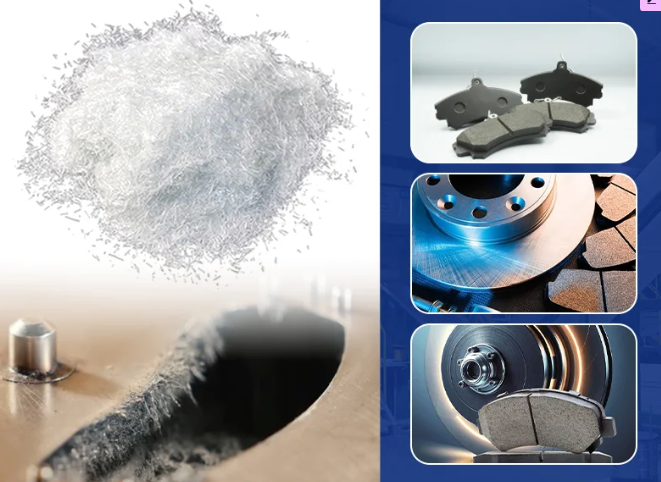
Customer Profile: Automotive parts suppliers, industrial electrical equipment manufacturers. Products: Automotive electronic parts, connectors, industrial insulators, high/low voltage electrical switches. Core needs: High mechanical performance, high heat resistance, long service life.
Recommended Solution:
Resin System: PA, PBT, PET, EP, VE (Engineering Plastics/High-Performance Resins)
Chopped Strand Type: PA-specific chopped strands (suitable for high-temperature engineering plastics); BMC-specific chopped strands (for BMC/DMC molding).
Length Specification: 6mm (high reinforcement for maximum strength); For complex structural parts, choose 4.5mm for better flowability.
Process Compatibility: BMC/DMC molding, high-temperature injection molding.
Pitfall Warnings: Absolutely prohibit using PP chopped strands in PA or other engineering plastic systems. For high-voltage insulation parts, choose high-purity E-glass fiber chopped strands to ensure insulation performance.
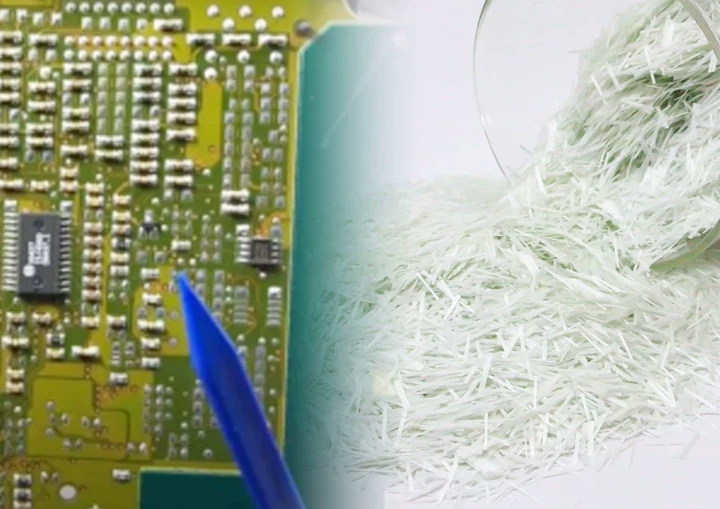
Customer Profile: Communication equipment manufacturers, high-end electronics brands. Products: 5G base station components, high-frequency communication structural parts, precision electronic components. Core needs: Ultimate dimensional stability, low dielectric constant, high reliability.
Recommended Solution:
Resin System: EP, VE, Modified PA, Specialty Engineering Plastics
Chopped Strand Type: High-purity PA-specific chopped strands (low ion content for low dielectric performance), BMC-specific high-dispersion chopped strands.
Length Specification: 3mm-4.5mm (Precision parts prioritize 3mm for molding accuracy).
Process Compatibility: Precision molding, high-temperature injection molding.
Pitfall Warning: For high-frequency communication components, you must choose high-purity chopped strands with low ion content to avoid affecting signal transmission.
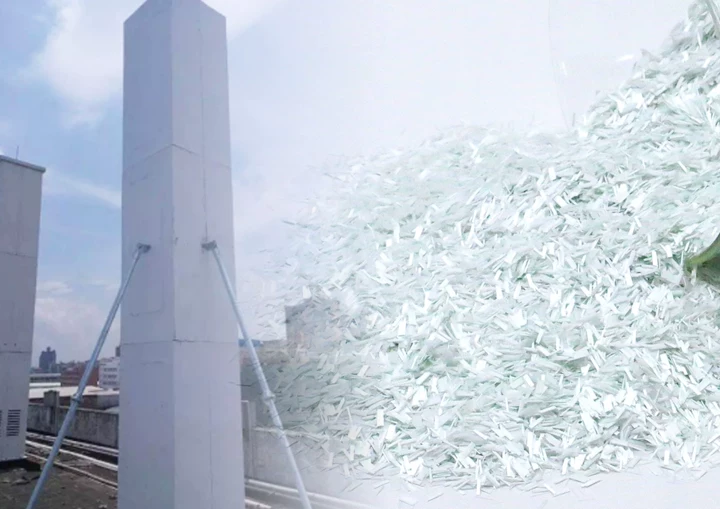
Based on years of customer service, here are frequently asked questions to help you avoid common selection and application pitfalls:
Myth 1: PP chopped strands are cheaper. Can I use them in PA resin to save costs?
Truth: Absolutely not. The surface treatment and high-temperature resistance of PP strands are incompatible with PA’s high processing temperature. Forced use leads to interfacial debonding and product failure, causing greater losses.
Myth 2: Longer is always better. Should I choose 6mm for all products?
Truth: Length must match product structure and process. Using 6mm for thin-walled precision parts causes molding defects. The core principle is “matching,” not “extremes.”
Myth 3: Can I use ordinary chopped strands for BMC/DMC processes?
Truth: BMC/DMC require high dispersibility and impregnation. Ordinary strands tend to agglomerate, significantly increasing reject rates. You must use process-specific grades.
Myth 4: Does glass fiber affect electrical insulation performance?
Truth: Quite the opposite. E-glass fiber itself has excellent insulation properties. When combined with resin, it enhances the reliability of insulation structures, making it a core reinforcement material for electrical insulation components.
Many customers focus only on the “unit price,” ignoring the “total process cost.” PP strands have a lower unit price but narrow compatibility; selection errors can lead to product scrap. PA strands have a slightly higher unit price but broader compatibility, enabling multi-material use and reducing after-sales costs. BMC-specific strands have a slightly higher unit price but significantly reduce reject rates, resulting in a lower overall cost.
Whether from the perspective of performance advantages, product diversity or technical services, Niumaterial’s glass fiber solutions provide a reliable choice for pipeline and tank manufacturing. By working with Niumaterial, companies can improve equipment performance, reduce costs, and take a more solid step on the road to sustainable development.
Our final advice to all customers:
Determine the resin first, then the strand type. Strictly adhere to the red line: “PA can be used for PP, PP cannot be used for PA.”
Match the process, choose the length. Balance reinforcement effect and process flowability.
Use process-specific materials, reject general-purpose ones. BMC/DMC processes must use dedicated chopped strands.
Choose a professional supplier who provides full technical support from selection to process optimization.
Adopt a lifecycle cost mindset – consider product performance, reject rates, and after-sales costs to select the optimal solution.
Glass fiber chopped strands may seem like a “small material” in electronics and electrical manufacturing, but they directly determine product strength, reliability, durability, and competitiveness. Correct selection not only solves problems like cracking, warpage, and insufficient performance but also enhances design freedom, enabling lightweighting and high-performance product upgrades, creating long-term value for customers.
As a professional glass fiber supplier, we not only provide high-quality PA-specific, PP-specific, and BMC-specific chopped strands but also offer full technical support covering selection, resin compatibility, process optimization, and quality control. We help you build high-performance, high-reliability electronic and electrical products to gain a competitive edge. If you have specific product requirements or process questions, please feel free to contact our technical team for a one-on-one customized selection solution.

If you have any questions
Please contact us for free consultation and product quotation

You can leave your needs and contact information~and We can provide you with usage suggestions + product suitability analysis + free sample delivery!
Leave us your interest and contact information, and we’ll send you detailed information for your reference!
You can leave the specifications and contact information you need~ Our technicians will immediately organize the exclusive information for you and send it to your email!
You can leave your contact information here, and we will send you detailed specifications and application cases to make your purchase clearer~