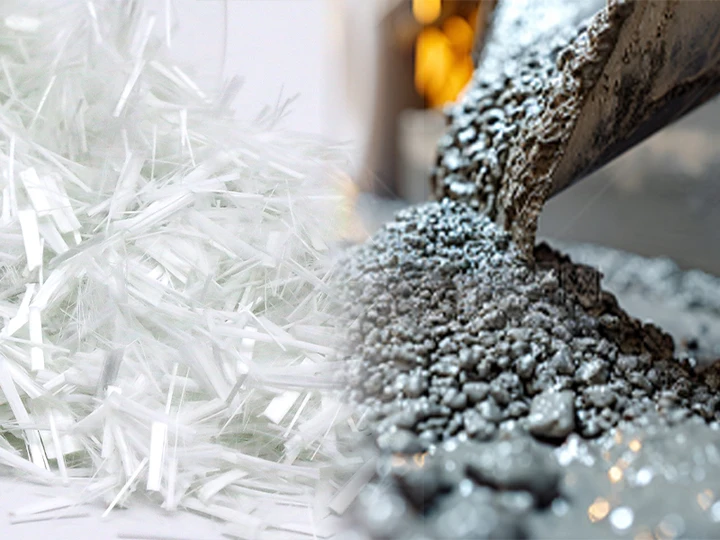
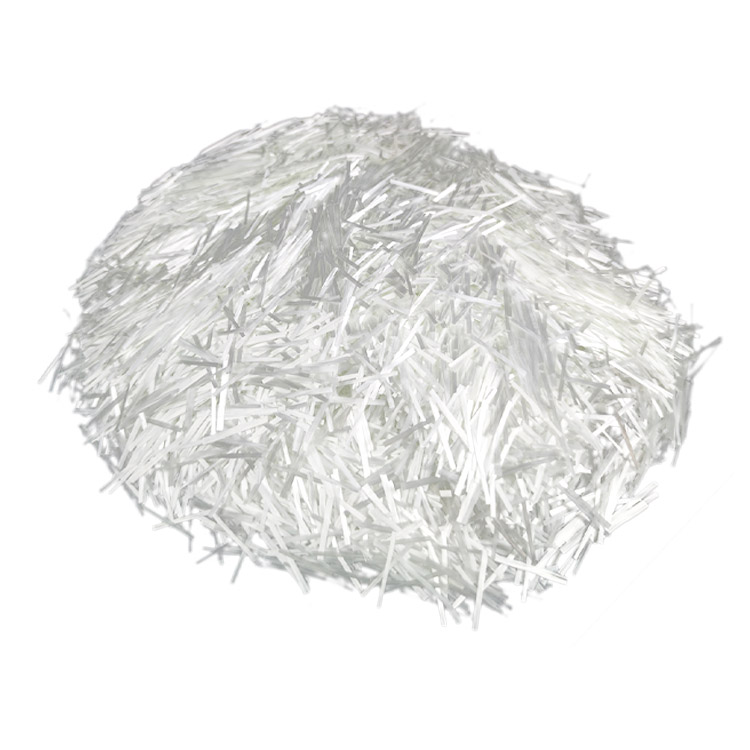
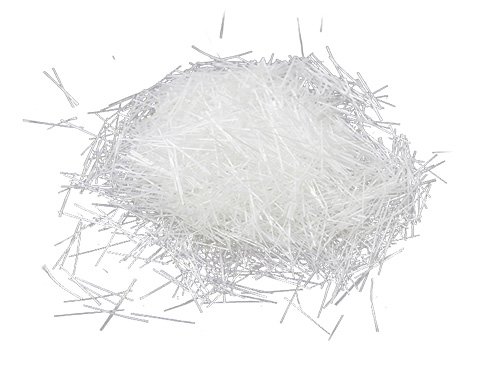
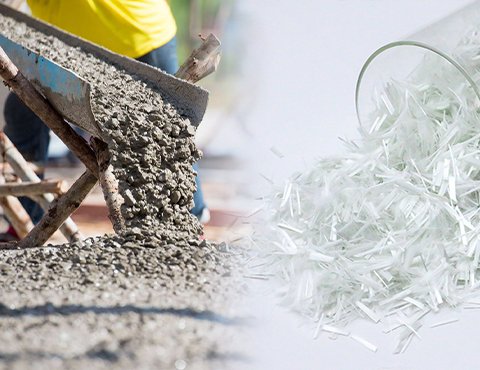
Why Glass Fiber Chopped Strands Are Making a Comeback in the Concrete Industry
Table of Contents
Add a header to begin generating the table of contents
Introduce
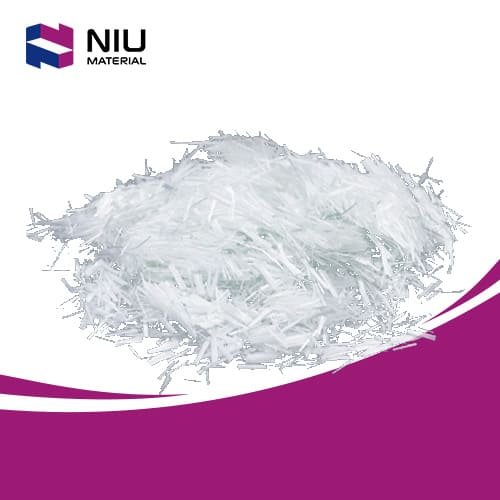
As practitioners, purchasers, or project managers deeply engaged in concrete engineering, we have all faced similar frustrations: ordinary concrete cracks easily, has poor impermeability, and leads to high post-construction repair costs; reinforced concrete is prone to corrosion in saline, alkaline, and humid environments, shortening the service life of buildings; traditional fiber-reinforced materials either have low cost-performance ratios or are cumbersome to construct with poor adaptability. A few years ago, the application of glass fiber chopped strands in the concrete field was lukewarm, even labeled as a “niche consumable” by some. However, in the past two years, this material has made a strong comeback, becoming not only a popular choice for municipal engineering, prefabricated construction, floor construction, tunnel support and other scenarios, but also a core auxiliary material for many customers to control costs and improve project quality.
Glass fiber chopped strands are not new materials, but their resurgence in the concrete industry is no accident. Putting aside manufacturers’ promotional gimmicks, from the real needs of our customers, this “comeback wave” is essentially a precise match for four core demands: material performance upgrading, cost control requirements, industry standard iteration, and construction efficiency improvement. Next, from the frontline engineering perspective, we will deeply analyze the underlying logic of its popularity to help you judge whether this material is suitable for your projects.
Solving Industry Chronic Problems: Targeting Core Pain Points of Concrete Engineering
To this day, the concrete industry cannot avoid several headaches for customers: first, cracking issues – ordinary concrete has low tensile strength, and is prone to plastic and structural cracks affected by temperature changes, dry-wet cycles, and load stress, which not only affect appearance but also weaken structural stability; second, insufficient durability – in high-corrosion environments such as coastal, saline-alkali, and underground areas, steel bar corrosion and expansion cause concrete cracking, and maintenance and replacement costs far exceed upfront investment; third, low construction efficiency – traditional steel bar binding and steel wire mesh laying are complex, time-consuming and labor-intensive, delaying the construction period; fourth, urgent demand for lightweight – prefabricated buildings, special-shaped components, and high-altitude construction have extremely high requirements for material weight, and heavy traditional concrete is difficult to adapt.
In the past, we tried alternatives such as steel fibers and synthetic fibers, but steel fibers tend to clump and are costly, while synthetic fibers have poor high-temperature resistance and limited strength improvement. The alkali-resistant modified glass fiber chopped strands precisely hit these pain points, becoming the most cost-effective solution.
Highlighted Core Advantages: Hardcore Value from the Customer Perspective
Superior Crack and Impermeability Resistance, Greatly Reducing Later Operation and Maintenance Costs
Alkali-resistant glass fiber chopped strands are uniformly dispersed in concrete to form a three-dimensional network support structure, dispersing stress and inhibiting crack generation and expansion like countless “micro steel bars”. Measured data shows that concrete mixed with an appropriate amount of glass fiber chopped strands has over 60% improvement in crack resistance and about 50% improvement in impermeability, effectively blocking the intrusion of moisture, chloride ions, saline-alkali and other harmful substances, and prolonging the service life of concrete structures from the root. For us customers, this means a significant reduction in the frequency of later repairs and renovations, directly cutting the full life cycle cost.
Corrosion and Weather Resistance, Adaptable to Extreme Construction Environments
Glass fiber is an inorganic mineral material. After alkali-resistant treatment, it does not undergo electrochemical corrosion like steel bars, nor does it age and degrade like synthetic fibers under high temperature and ultraviolet radiation. Whether in coastal cross-sea projects, northern freeze-thaw areas, underground tunnels, or chemical corrosion sites, glass fiber chopped strands can maintain stable performance, enabling concrete structures to withstand harsh environments for a long time – an advantage that traditional reinforced materials cannot match.
Lightweight and High-Strength, Balancing Structural Safety and Construction Convenience
Compared with reinforced concrete, the self-weight of concrete components added with glass fiber chopped strands can be reduced by 30%-70%, while the bending and impact strength is significantly improved. It can not only meet the structural requirements of load bearing and support, but also reduce foundation load and transportation and hoisting costs. Moreover, chopped strands can be directly put into the mixer for synchronous mixing with concrete, with good dispersibility and no agglomeration. No additional steel bar binding or steel wire mesh laying is required, the construction period of a single project can be shortened by 15%-30%, and labor costs are greatly compressed.
Outstanding Cost-Effectiveness, Adaptable to Projects of All Budgets
With the maturity of production technology, the price of glass fiber chopped strands continues to decline. A dosage of only 0.3%-1% of the total concrete volume can achieve the ideal reinforcement effect, and the comprehensive cost is much lower than that of steel fibers and high-quality synthetic fibers. Whether it is a large-scale municipal project, commercial real estate, or a small floor and slope protection project, the dosage can be flexibly adjusted according to the budget to balance performance and cost.
Strong Plasticity, Meeting Customization Needs of Special-Shaped Components
Nowadays, scenarios such as prefabricated buildings, landscape components, and art floors have increasingly high requirements for concrete modeling. Glass fiber chopped strands do not affect the fluidity and plasticity of concrete, and can easily pour curved, hollow, and special-shaped components, breaking through the modeling limitations of traditional reinforced concrete, and helping projects achieve dual upgrades of design aesthetics and structural performance.
Boosted by Industry Iteration: Policies and Standards Drive Demand Surge
In addition to its own performance advantages, the overall industry environment has also accelerated the popularity of glass fiber chopped strands. On the one hand, China is vigorously promoting the development of green buildings and prefabricated buildings, putting forward higher requirements for the lightweight, durability and environmental protection of building materials. The rust-free, low-energy consumption and recyclable characteristics of glass fiber chopped strands perfectly meet the green building material standards. On the other hand, the industry standards for concrete reinforced materials are constantly improving, and the quality inspection, dosage specification and construction process of alkali-resistant glass fiber chopped strands are becoming more mature, dispelling customers’ quality concerns and making large-scale application possible.
At the same time, project acceptance standards are becoming stricter, and the accountability mechanism for project quality is becoming more complete. Customers no longer only pursue low upfront prices, but pay more attention to long-term quality assurance. Glass fiber chopped strands can effectively improve project pass rates and reduce after-sales risks, naturally becoming a priority choice for customers.
Rational Selection: Practical Tips for Customers
Although glass fiber chopped strands have significant advantages, as customers, we still need to select rationally and avoid blindly following the trend: first, prioritize alkali-resistant glass fiber chopped strands, ordinary glass fiber is easily corroded by cement alkalinity with rapid performance attenuation; second, control the dosage according to the engineering scenario, low dosage is sufficient for crack resistance scenarios such as floors and slope protection, and the dosage can be appropriately increased for tunnels and load-bearing components; third, choose products from regular manufacturers to control core indicators such as fiber length, dispersibility and tensile strength to ensure construction effect.Whether from the perspective of performance advantages, product diversity or technical services, Niumaterial’s glass fiber solutions provide a reliable choice for pipeline and tank manufacturing. By working with Niumaterial, companies can improve equipment performance, reduce costs, and take a more solid step on the road to sustainable development.
Conclusion: Return to Essence, Practicality Is the Last Word
The comeback of glass fiber chopped strands in the concrete industry is not a temporary material trend, but an inevitable result of the market returning to rationality and the upgrading of customer demand. It has no fancy concepts, but can effectively solve engineering pain points, reduce costs and improve quality – which is exactly the core value we customers in the concrete industry value most. In the future, with the continuous upgrading of technology and the expansion of application scenarios, this material will surely become a mainstream choice in the field of concrete reinforcement, helping more projects improve quality and efficiency.
You can leave a message about the fiberglass materials you are interested in/looking for.
We will send you a clear quotation (including product price + shipping cost) within 12 hours.
Contact us via email
Please leave a message regarding the fiberglass and other composite materials you’re interested in or looking for.
We will send you a definitive quote (including product price and shipping costs) within 12 hours.
Are you considering fiberglass for your application?
You can leave your needs and contact information~and We can provide you with usage suggestions + product suitability analysis + free sample delivery!
Leave us your interest and contact information, and we’ll send you detailed information for your reference!
Do you want to know the technical parameters and TDS of products?
You can leave the specifications and contact information you need~ Our technicians will immediately organize the exclusive information for you and send it to your email!
Interested in this specification?
You can leave your contact information here, and we will send you detailed specifications and application cases to make your purchase clearer~
How can we help you?
You can leave a message about the fiberglass materials you are interested in/looking for.
We will send you a clear quotation (including product price + shipping cost) within 12 hours.